
Cover image: Listening Devices by Caitlind r.c. Brown & Wayne Garrett. Photo by Caitlind Brown
EARS HAVE EYES // Episode 53
Airing Wednesday, August 12, 2026 at 11 am & 8 pm MST
on CJSW 90.9 FM, NAISA, & Golden Co-Op Radio
AGOROPHONIC:
wide open sounds, wide open spaces
FEATURING:
Ali Balighi
Cristian Argento
Jonty Harrison
Kasey Pocius
Panayiotis Kokoras
Valentin Sismann
This program is co-hosted by Caitlind r.c. Brown & Wayne Garrett and edited by Caitlind Brown. Thanks to CJSW, Golden Co-Op Radio, and NAISA (especially Kaamil, Claire, and Darren) for supporting the show.

EARS HAVE EYES is a monthly sound art radio program airing on CJSW 90.9 FM in Calgary/Mohkinstsis, Golden Co-op Radio in Golden, BC, and NAISA Radio in South River, Ontario. You can listen to podcasts of previous episodes here.
Agoraphobia speaks to a fear of wide-open spaces. With this month’s program, AGORAPHONIC, we’re exploring sonic spaces so wide, they threaten to swallow us up. The artists on today’s program capture mountain sides and “mute streets,” the calm before the storm and the erosion afterwards, the space inside a piano and the collapse inwards of an agoraphobic person at the threshold of their home… and everything in-between.
Thanks to the participating artists and our friends at CJSW, NAISA, and Golden Co-op Radio!

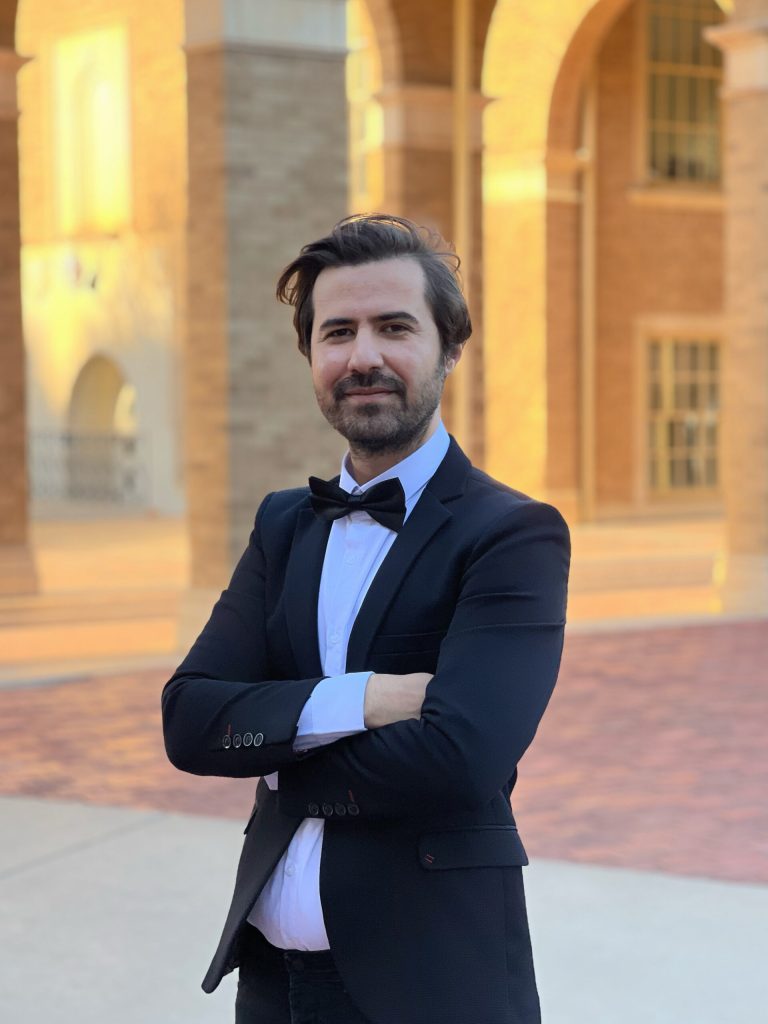
Ali Balighi
Ali Balighi is a composer, sound designer, and sound engineer born in Tehran, Iran. He graduated from The University of Art in 2011 with a Bachelor’s degree in Music Performance. A passion for composition led him to pursue a Master’s degree in Composition at Texas Tech University, where he is currently a student for a Doctor of Musical Arts (DMA) in Composition.
The Mute Choir of the Streets is a multichannel sound composition that explores the complexities of free speech and urban anonymity through a blend of field recordings, microtonal tuning, and processed sacred music. By utilizing 31-tone equal temperament (31-EDO) and granular synthesis—specifically applied to Arvo Pärt’s Psalm—the piece dissolves traditional harmonic stability and spiritual clarity into a dense, everyday soundscape. This sonic environment serves as a metaphor for the “mute choir”: the collective of voices that, while physically present, remain politically or socially unheard. Ultimately, the work challenges the listener to navigate the thin line between voice and noise, examining how power and recognition are distributed within the chaotic background of modern city life.

Cristian Argento
Cristian Gabriele Argento, Italy, Electroacoustic composer. Born in Catania in 1998, Cristian started to make music as a self-taught at the age of 14. His interest in new technologies applied to music was born in high school, studying subjects such as electronic and computer science; during this period he did some extra school courses about new technologies and electronic music. After his high school studies he decided to make of electronic music his future so he decided to enroll at the conservatory of Palermo. Currently he attends the second year of the Master course of electronic music at the conservatory of Palermo in the class of Giuseppe Rapisarda.
Uggiosa Prigionia takes shape as a sonic portrait of an extremely circumscribed everyday experience: the only moment in which an agoraphobic person exposes themselves to the outside world, remaining on the threshold of their domestic space. Rather than depicting an environment, the work investigates a perceptual mode, a tense and fragmented way of listening.
The emerging soundscape is deliberately indistinct. Concrete sounds seem to lose their substance, as if caught only in passing, filtered through a state of constant alertness. Nothing asserts itself with clarity: acoustic reality remains suspended and unstable, permeated by a subtle sense of unease. This blurring is not merely a timbral effect, but a sonic translation of dissociation, of a body struggling to recognize and organize what it perceives.The balcony thus becomes a symbolic place, a threshold that does not simply separate inside from outside, but safety from vulnerability.
Listening unfolds in a precarious balance, oscillating between the desire for openness and the need for control.
At a certain point, this tension intensifies to the point of producing a perceptual rupture: the sonic material fragments, losing continuity, as if the senses were suddenly overwhelmed.What remains, after this passage, is a sense of silent retreat—not liberating, but inevitable. A return to the interior that preserves the trace of the exterior, like a lingering echo.

Jonty Harrison
Jonty Harrison (1952) studied at the University of York, before working at the National Theatre and City University, London. In 1980 he joined the University of Birmingham, where he directed the Electroacoustic Music Studios and BEAST. He retired in 2014 and is now Emeritus Professor of Composition and Electroacoustic Music. Gastprofessur, TU, Berlin (2010); Leverhulme Emeritus Fellow (2014-15). Compositeur Associé, Maison des Arts Sonores/KLANG! Acousmonium, Montpellier, France (2014–). He has received many commissions and prizes internationally, and his work appears on four solo albums (empreintes DIGITALes, Montreal) and several compilations.
About Off-Piste:
“Maybe I should have tried skiing when I was younger – nowadays, I can think of few things more terrifying than hurtling off the edge of a mountain with a plank of wood strapped to each foot, holding only a couple of sticks! I can still manage to climb aboard a cable car, however, and up above the clouds another world is revealed: clear blue skies, stunning views over huge distances, the whirring and clanking of ski lifts… and the sound of people apparently enjoying themselves, whilst simultaneously courting disaster. Baffling!”

Kasey Pocius
Kasey Pocius is a gender-fluid intermedia artist and researcher based in Montreal, teaching at Concordia and active with CIRMMT, IDMIL, LePARC, and GRMS. They create electroacoustic and audiovisual works that explore interactive electronics, spatial sound and collaborative improvisation, with pieces programmed globally from DIY spaces to Harvard.
Weaving together field recordings taken during heat waves in Montreal & Cheltenham and synthesizer improvisations recorded while processing the breakdown of a romantic relationship, Waiting on the Storm to Break the Heat explores the dread and calm before the catastrophic, and the relief found thereafter. Through intermodulation of the synthesized elements and transformations of both materials, the summer storm depends on the heat and, for a moment, provides relief, allowing the listener to find a new balance in the aftermath.

Panayiotis Kokoras
Panayiotis Kokoras is an internationally acclaimed composer and computer music innovator, serving as Regents Professor of Composition and Director of the Center for Experimental Music and Intermedia at the University of North Texas. His work centers on sound as the primary structural element, articulated through his concept of Holophonic Musical Texture, and integrates research in timbre, extended techniques, robotics, spatial audio, and music information retrieval. His music has received over a thousand performances worldwide and numerous international awards, including honors from the Guggenheim Foundation, Prix Ars Electronica, Giga-Hertz Award, and other major institutions and festivals.
Magic (2010) for electroacoustic sounds was composed during a four-week residency at the ZKM studios in Karlsruhe and commissioned as part of the Giga-Hertz Production Award. The third and final work of the Grand Piano Trilogy, it distills an extended exploration of the piano as timbre, space, material, vibration, and cultural memory. Derived from more than seven hours of recordings captured around, below, and inside the instrument, over six hundred meticulously connected sounds were shaped through pitch tracking, physical modeling, music information retrieval tools, and multichannel diffusion techniques. Originally conceived for 32 channels and premiered in the KlangDome at ZKM, the work fuses transformed piano sonorities with subtle references to repertoire including Ravel, Beethoven, Webern, and Cage, creating a virtuosic continuum of motion and resonance. The title evokes Arthur C. Clarke’s notion that sufficiently advanced technology becomes indistinguishable from magic, suggesting an experience that resists rational explanation while unfolding with precision and sonic intensity.
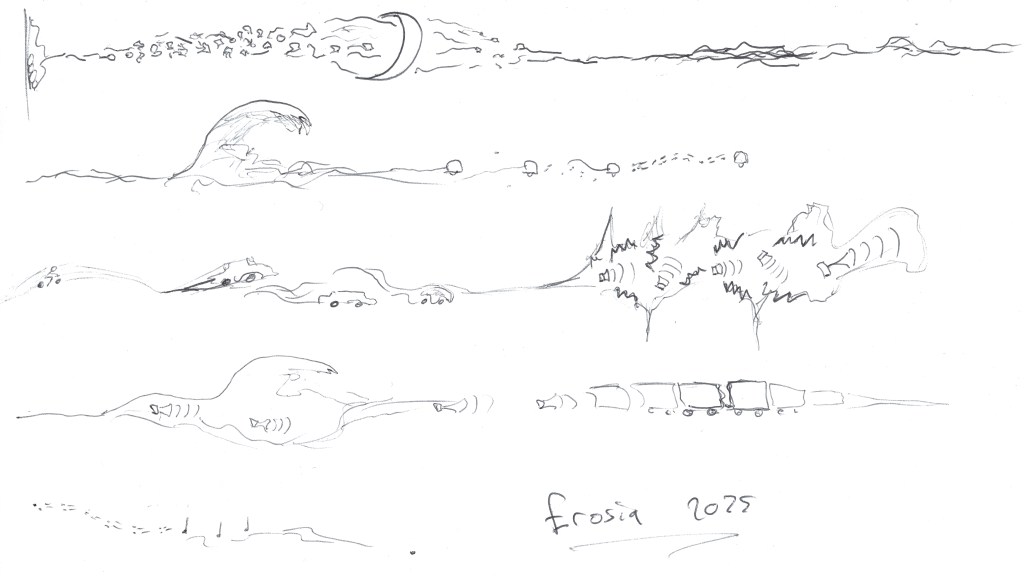
Valentin Sismann
Valentin Sismann (born in 2002 in France) develops a practice that combines acousmatic composition and video. He explores the idea of expanded music, where sound and visuals are expressed in ways that are either poetic, narrative, or conceptual. His works focus on our relationship with technology, particularly recording media, which he questions and manipulates within critical or imaginary spaces.
Aboute Erosia:
“Beneath the cliffs, the sea crackles. Secret life of the waves, of the wind, without anyone, existing. Outside, a shitstorm of machinery and bodies. Consuming. A pseudo-embodiment of the living.
Two impressions of the same show. Erosion, scum. Autophagy is fantastic. Especially in music: l’art se nique.”

Thank you to the artists & listeners!
Special thanks to CJSW.
Want to share your sound art on future episodes of EARS HAVE EYES?
Visit this link for more information.
 THE HIBERNATION PROJECT